

The Brand of the Future
the necessary-- and next-- trend in business strategy

This kicks off a series called Value Builders, where each post is a profile of a leader behind positive value-first brand strategy/turnarounds.
Brian Niccol, the new CEO of Starbucks, has two nicknames: Mr. Fix-It and Brian Nickel-And-Dime1. The industry moniker Mr. Fix-It was earned via Niccol’s track record of rescued brands, famously including Taco Bell and Chipotle--- a track record which Starbucks hopes will soon include its failing company; Brian Nickel-and-Dime is the nickname given to him by my brother’s best friend, a customer-given name that demonstrates Starbucks’ strained customer-brand relationship, suggestive of inauthenticity and exploitation. These nicknames establish two things: that there is a problem somewhere within the Starbucks brand that needs to be fixed, and that this problem is one of deep consumer unhappiness.
But the problem is much bigger than Starbucks. Overpriced coffee drinker or not, the retail experience matters. As a mainstay of daily life, it has always provided and been informed by community, trust, discovery, and hope. The current retail landscape offers none of these. Shopping is aspirational. People shop because they need or want a product that is going to make some aspect of their life better. Without trust--- which comes with community, product knowledge, and good service--- the customer’s ability to accurately select a product that will improve their life or fulfill their need is not only limited but impeded; without discovery, they are similarly impeded. But what’s more is that the retail and service experience had the ability, through discovery and community, to insert enjoyment, hope, and human connection into the mundane, into the everyday. Without this opportunity, our lives are duller, bleaker, disconnected, uninspired. Wouldn’t you like to be excited, hopeful, and engaged on a daily basis again? Wouldn’t you like to be inspired again?
Consumers want and even require change, a fact that has finally begun to show itself in quarterly earning reports and is evident in store shutdowns and bankruptcies, causing massive rebrands, redirections, and strategy pivots across the retail and service industries. The decline of retail has been a long time coming, and in fact has probably already been here for some time. But why is it happening, and what can be done to revitalize it?
Brian Niccol believes that the change necessary is one towards reconnection and authenticity, a return to roots and human interaction, to non-algorithmic personalization, and to enjoyable everyday experiences. While the efficacy of Niccol’s Back To Starbucks plan, by which Starbucks is attempting to reestablish its prior-enjoyed status as a “third place”, is yet to be seen, it pinpoints the cause of consumer dissatisfaction across retail and service experiences as one of neglect--- the neglect of three crucial values in positive user-centered design: connection, engagement, and enjoyment.
Niccol is not alone in this thinking; many other prominent companies, like Barnes and Noble and Best Buy, are working towards brand revitalizations that center these same values. In the late-stage capitalist era, the path forward for retail and service strategy is a return to user-centered design that engages and excites the user rather than tricks, tracks, or traps them. The timely Starbucks rebrand, successful Barnes and Noble takeover, and ongoing Best Buy revamp prove that this direction for design is not only gaining momentum, but is in fact an attractive and potentially effective strategy to save companies from the consequences of deprioritizing user wants and needs. Positive user experience design works, and connection, engagement, and enjoyment matter--- disregarding them will no longer provide profit.
Positive user experience design is design that not only meets the needs of users, but also improves their well-being and enjoyment. As of late, many companies have relied on its evil twin, negative user experience design. Negative user experience design consists of confusing, frustrating design, but also design tactics like dark patterns, which deceive, manipulate, or coerce users. This can refer to excessive data collection; vulgarization, by which design is simplified to the point of dumbing down; gamification, which conditions users to continue performing a certain action for dopamine; infinite scrolling; and incessant notifications. I would like to propose an alternative design strategy that prioritizes the user’s well-being and is still lucrative. This strategy is user-first human connection and engagement/excitement.
Back To Starbucks
Back To Starbucks is a strategy that seeks to reestablish Starbucks as a “third place”, somewhere that is neither home nor work where people can gather, connect, and build community. There has been significant musing about the psychological benefits of such a place, and also about the psychological impact the modern loss of third places has had on society (some think online is a third space, but then online became our work and school). This loss can be attributed to a general lack of safety or mistrust of spaces that are not home or work, and also the displacement of third spaces by online communities. But whatever the reason, there has also been a significant longing for their physical return. Starbucks’ brand, from the beginning, was centered around the idea of a third space, but recent brand strategy has diverted from that concept, causing Starbucks’ brand identity and therefore experience to be unfocused, confusing, and unpleasant. This includes changes like the creation of pick-up only stores, the elimination of in-store seating, the automation of ordering getting rid of the need for Sharpie messages on cups--- which Niccol famously brought back, having to buy 200,000 Sharpies--- and an emphasis on mobile ordering, speed, and convenience that served Niccol so well with other brands. Niccol believes that this turn from the brand’s original identity was a mistake. He thinks that people want conversation, relaxation, and a break from the pressures of the day when they come to Starbucks, not to be rushed out and treated like a number.
Back To Starbucks includes several design tactics/updates cultivated for lending Starbucks a cozy hometown café air. The condiment bar with sugar, cream, stirrers, straws, napkins, and lids has returned from its behind-counter exile; Sharpies have come back; here-ware, or ceramic mugs and glasses, are offered to customers staying in-store; and Starbucks is rolling out something called Green Apron Service, a revamped customer service model that encourages employees to follow Five Key Moments as guidelines for customer interaction. The Five Key Moments are as follows: 1) Warmly greet the customer; 2) Offer for here-ware; 3) Craft beverage and write a personalized message on the cup; 4) Direct handoff with a hand-to-hand connection; 5) Check/clean lobby and condiment bar. The Five Key Moments operationalize customer connection, embedding positive social interaction into the Starbucks experience in the hopes that it will bring back customers and beat out competitors in an era where there is no human connection involved in the average purchase. Starbucks is pivoting towards a pre-automation authenticity and emphasizing the experiential engagement potential of coffee-buying because its previous unemotional, mechanical operations did not differentiate it as a coffee chain. They did not incentivize going to Starbucks over making coffee at home or going to a competitor, who can do the same thing. Starbucks is moving towards these values to stand out.
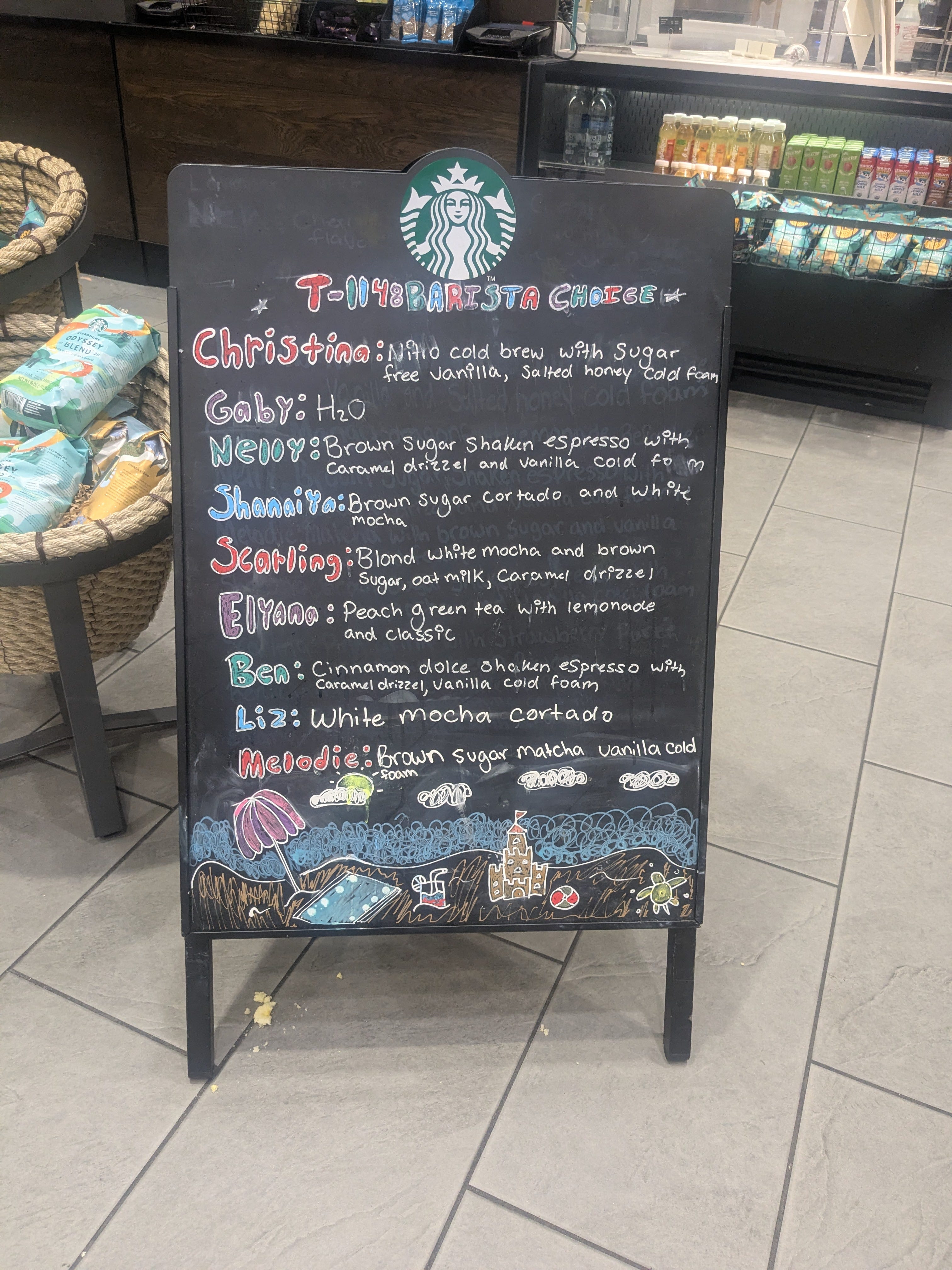
At my local Starbucks (one of the ones in Target) I came across a chalkboard sandwich board with pastel bubble letters spelling out each barista’s name and their personal drink recommendation. I have never seen a Starbucks do this before, but I am aware of the common request and even trend, “Make me your favorite drink”. Not only did this sandwich board hint towards the trend or prior conversations that incorporate human connection, it built empathy for baristas, increases the chance of pleasant discovery, suspense, and surprise, and is a conversation starter with the barista, which sparks further human connection. I was endeared instantly, and while I did not purchase a drink, a smile was brought to my face imagining the seven bubbly, warm baristas taking the time to personally recommend me a beverage. I certainly felt a sense of community--- and all this in a Target.
Whether or not Back To Starbucks will be a success has yet to be seen, but it is not the only company moving towards authenticity, connection, and a different kind of engagement and enjoyment than the all-too-familiar attention economy strategies of gamification and algorithmic tracking. Barnes and Noble and Best Buy are adopting similar strategies. Barnes and Noble, who faced declining sales since 2012, has revitalized itself after its acquisition by bookstore mogul James Daunt in 2019. Under Daunt, the chain has opened numerous new locations every year and has seen skyrocketing sales, an impressive feat considering the mid-2000s consensus that bookstores are dead. Daunt’s gameplan is similar to Niccol’s: bring back the third space, emphasize community, and make the purchasing experience engaging and enjoyable. Barnes and Noble has implemented this plan to outstanding success. Barnes and Noble’s return from the brink of death in the 2010s--- buckling under Amazon’s online prowess and e-reader success— to a bookselling juggernaut who opened sixty new locations last year and is opening sixty more this year, is an attestation to the power and efficacy of benevolent, engaging, human design.
Books-First
Daunt, who also boasts an impressive industry track record, having founded Daunt Books in the UK and having rescued the bookstore company Waterstones, has pioneered several user experience design changes among Barnes and Noble stores that reflect a customer-first, books-first mindset. His main objective upon acquiring the chain was to turn over control of each bookstore to its local community, allowing each location to cultivate its own culture, style, and experience. This included strategies like allowing stores to design their own store layout, and even giving them the power to change it regularly with innovative modular shelving units (that have different depths to accommodate books of all sizes and can be unclipped from the wall to become freestanding displays), encouraging dynamism; ditching the racetrack layout that placed cash registers by the door and encouraged impulse buys; loosening brand consistency with logos, colors, and store designs; hiring full-time employees rather than part-time ones to ensure dedication and community; and two impressively daring and human moves: eliminating footfall counters that track the number of customers exiting and entering, and terminating deals with publishers that allowed them to pay for better book placement, allowing the booksellers at each individual store to decide what books to promote.
And the results show. Barnes and Noble’s return rate dropped from a towering 30% to a low 7%, meaning that customers are more satisfied with the books they buy, and Barnes and Noble is making more money--- because customers are getting recommended books they want to buy through human connection, not what they don’t actually want through paid publisher promotions or algorithmic recommendations. This success emphasizes that doing the wrong thing for the customer in favor of short-term financial gains is not better than doing the right thing for them. The right thing for the customer can be financially beneficial. The new model makes Barnes and Noble money, too--- less people returning books means less money Barnes and Noble loses.
Since the changes, I have found myself enjoyably lured into the many browsable freestanding tables that greet me when I walk through the doors of my local store, and almost immediately find something riveting under a catchy sign denoting small-town mystery, instead of having to pigeonhole myself to one particular section. My heart has been warmed, too, by the handwritten notes accompanying certain books, explaining the premise and tags of each bookseller’s own personal recommendation. Upon first seeing this, I was certain a customer had done it and that it would soon be taken down. I was elated at finding out this was the new direction Barnes and Noble was moving in. I felt cared about.
One of my most memorable book shopping experiences was seeing an endcap all full of books wrapped in brown paper and tied up with bows: the Blind Dates With A Book books. Notes on them read: Romantasy, Mystery, Enemies To Lovers, Dark Academia, etc., a series of tags readers use in the book community in conversation with each other to recommend books, but that are rare to see in any official capacity. These words instantly, because they were the language of an existing community, not only suggested a culture and a sense of belonging in their usage alone, but gave me an understanding of each of the books that lay hidden beneath the paper that I couldn’t have gotten from the back of the book. My local Barnes and Noble had lovingly selected and wrapped each and every one of the books, tagged them, and displayed them in the hopes that the customer would discover something new and experience the enjoyment of suspense, mystery, and surprise. That day was engaging, exciting, and connecting--- all things online book shopping often fails to be.
Renew Blue: 2012-2019
The third brand to implement a much-needed change in design tactics is Best Buy. When I was a kid, Best Buy was a wonderland, almost as good as Toys “R” Us (which has since gone out of business, and even after that failed to make a comeback, proving Best Buy’s resilience). It was a whole new world full of devices and media I could hardly comprehend, devices that felt futuristic, exciting, and fun. There were endless options and new discoveries that happened between its walls. But when I was about thirteen, my dad took me and my twin brother into Best Buy to pick out a present. Upon entering, we realized that it had changed. This was not the wonderland any of us once knew. Plain, drab, fridges and washing machines held no appeal to thirteen year olds, and I honestly don’t think they held much appeal to fifty-year-olds, either. What had happened?
In the past several years, Best Buy has struggled to maintain relevance, reporting declining foot traffic and sales for nearly a decade. One redditor wrote two years ago that Best Buy was like a “pig fattened up and ready to be put to market” . Best Buy has begun exhibiting the harbingers of doom for a failing business, chiefly laying off specialized employees and eliminating specialized departments, like its employees dedicated to mobile sales and activation. There have been numerous complaints of slow shipping times and poor customer service, and during a time when a wider variety of products are cheaper elsewhere, the most important leverage, in-store experience---excitement--- is lacking. Best Buy is another victim of the consumer behavior shift from brick-and-mortar stores to online shopping, but it has also been faced with a more unique struggle, the issue of product: the variety of products necessary in its boom--- physical media like CDs, Xbox games, Steam games, and DVD; different consoles; MP3 players; PDAs; and GPSs --- has been significantly reduced by the smartphone. And there is not anything particularly exciting about a store full of smartphones (or fridges, or washing machines). Best Buy has failed to stay engaging.
In 2012, Hubert Joly took over as CEO of the brand, and is credited with somewhat reinvigorating the brand with his hospitality-focused strategy called “Renew Blue”. “Renew Blue” consisted of five pillars of transformation: 1) reinvigorate and rejuvenate the customer experience; 2) attract, grow, engage, and inspire transformational leaders and employees; 3) work with vendors and partners to innovate and drive value; 4) increase return on invested capital; 5) continue leadership role in positively impacting the world . These pillars involved price matching qualified competitors to combat “showrooming”, where customers came to Best Buy to browse and then completed their purchase outside Best Buy, like on Amazon; a relaunch of the loyalty program; increased locations offering Ship-From-Store; partnered with Microsoft and Windows to create stores within a store; and strengthening the product knowledge and service aspects of the company, like better integrating Geek Squad into the mobile and web experiences.
The strategy proved to be a huge success, demonstrating the importance of engagement and the customer experience. But while the strategy caused somewhat of a resurgence from 2012-2019, the brand has since declined again under CEO Corie Barry. Barry’s next technique is to tackle the engagement problem with a new branding strategy with the tagline “Imagine That”.
Imagine That.
CEO Corie Barry, who during Joly’s reign was chief financial and transformation officer, has been under fire for squandering Joly’s hard-earned success. Barry reinforced the neglect of positive design values by fundamentally misunderstanding the Best Buy user. She boiled the Best Buy consumer down to deal-savvy sales hunters, disregarding the importance of the unique retail experience that Best Buy can offer and positioning Best Buy as a Target and Walmart competitor rather than a place that offered engaging, exciting in-store experience, customer service with unique product knowledge, and luxury big-ticket goods2. Instead of focusing on the Geek Squad and in-store displays, for example, Barry removed employee specialization, ended commission for affiliates and influencers, and practically eliminated big spenders by pigeonholing Best Buy into a cheap, average store. The problem with Best Buy as a Target and Walmart competitor is that it has a smaller range of products, can’t compete in terms of sales, and has a brand identity that doesn’t match this image, so it will never be a “deal-savvy” customer’s first thought, or even second thought.
Best Buy’s lingering brand identity, which it needs to return to instead of run from, is one of specialty and expertise. Best Buy should be a place where the discovery of new products occurs, a discovery that is necessarily exciting; where play and experimentation occur, which increases engagement and foot traffic; and where there is product knowledge and service unparalleled by other stores in the technology and home appliance domain. The average consumer doesn’t know the difference between two same-size TVs or two new phones; Best Buy should. This is what customers want and need from Best Buy, and what would lend it staying power in the modern era: something that they can’t get anywhere else, and something that they are desperately searching for--- discovery, engagement, and human connection.
Lately, Barry has pivoted to a new strategy that claims to emphasize these values--- the “Imagine That.” strategy. “Imagine That.” seeks to reframe Best Buy as a place of imagination, discovery, modernity, and service through more interactive in-store displays and partnerships, a “spokeshologram” --- hologram spokesperson --- Gram, and new specialized product reviews and recommendations in the form of video content. Imagine That will oversee a new Discover tab in the Best Buy app for exploring new technology, experiential displays with brands like Tesla and GoPro, a Best Buy YouTube channel with over 500 videos featuring buying guides, new product showcases, and “tech tips” , and the return of in-store specialization. Even the wording used in the Best Buy blog post announcing this new chapter is evocative of excitement and discovery, referring to the goal of the store to make you think “What If?” While this new strategy certainly has its work cut out for it, Barry seems to have finally realized the direction Best Buy needs to go in: the human direction. I hope that other brands follow suit.
Starbucks, Barnes and Noble, and Best Buy were giants in my childhood--- sources of inspiration, fun, and connection. Sources of excitement, of hope. I remember fondly in my preteen years trying to impress friends by ordering off the Starbucks secret menu, competing to see who could give the funniest fake name for the barista to call out and write on our cups, and the joy of getting the first pumpkin spice latte of the season together after school; judging a book by its cover at Barnes and Noble--- when all of the covers still looked different--- and finding cozy chairs scattered throughout the aisles to read our respective books in, passing the time easily, without pressure to either spend money or get out; squealing to friends when the protagonist’s love interest did something swoon-worthy and listening excitedly to regular updates of what was happening in their books as well; of being greeted with a detailed list of pros and cons when I asked a salesman in Best Buy which phone to purchase upon buying my first one; and of hours spent trying out the Wii and discovering new music in the CD section.
But then, something happened. They--- along with countless other brands, most of whom are no longer still standing--- were sucked into the undertow of the early aughts Internet ecommerce wave and beaten out by shopping and service that was convenient and cheap, but boring. Many brick-and-mortar operations, failing to keep up with digital demands or to compete with their new digital competitors, nearly drowned. The now haggard survivors try everything but the right thing to remain relevant in the aftermath. But these three may have cracked the code--- they have come to understand that their value is in what online shopping can’t provide: human connection, discovery, and hope -centered experience--- positive user design.
Happy New Year! I wanted to kick the year off with something a little hopeful. Like or leave a comment below if you agree about the brand of the future! Leave one if you don't, too!
During Brian Niccol’s roles as CMO and then CEO, the Taco Bell brand was completely revitalized and became a popular, trendy chain no longer famous for low-quality meat (as was alleged by a 2011 lawsuit for which the charges were then dropped, as Taco Bell meat was 88% beef, 12% seasonings and binders) but instead for fun menu options. He is credited with introducing the Doritos Locos Taco, an iconic Taco Bell staple; popularizing the Live Mas slogan; revolutionizing the digital app and mobile orders; and creating the Taco Bell Cantinas, special Taco Bell locations with adult beverages and exclusive menu items, all moves that brought Taco Bell not only into the present but also aligned it with youth culture. At Chipotle, Niccol swooped in after several food quality and safety scandals, like the 2015 e. coli crisis, and raised food safety standards, oversaw the addition of more and healthier food options and customizations, and, again, expanded Chipotle’s online ordering and delivery capabilities.
But despite his rosy reputation, Niccol’s Starbucks appointment has made him a surprisingly divisive figure, and his Back To Starbucks plan is similarly controversial. Niccol has drawn fire for understaffing; for his exorbitant salary, which a headline reported was 6666 times more than the median barista; unionbusting; new employee dress code; enforcing a paying-customer-only bathroom rule; and poor execution of the new rules and menu offerings.
https://medium.com/@omarjtrejo/why-best-buy-is-failing-under-ceo-corie-barry-analyst-breakdown-94e53ed7f701
A really great piece. I remember reading a book about Starbucks years ago and their strategy and found it really interesting. When I compare it to my local Starbucks, (which has now closed) it was so different. Lighting really low, it was dark, dirty, staff who didn't seem to care. It felt old and unloved and definitely not a 'third space' for the community. Will be interesting to see what happens next.